In high-security door systems, the lock is never a single component working in isolation. True resistance to forced entry depends on how the door leaf, frame, and locking points interact under sustained attack. For this reason, multipoint locking security doors have become the professional standard across high-value residential, commercial, and specialist projects.
As a leading UK manufacturer of bespoke security doors, Security Doors Factory designs multipoint locking as a core structural feature. It is not an optional upgrade. Instead, it is fundamental to how certified security performance is achieved and repeated across projects.
Why Multipoint Locking Is Essential in Security Doors
Single-point locks concentrate force in one area. Under leverage or prying, that concentration creates predictable failure points. Multipoint locking takes a different approach. It distributes locking forces across the full height and width of the door, anchoring it into the frame at multiple locations.
As a result, an attacker cannot simply target the lock cylinder or a single edge. Instead, they must overcome the entire door system at once. This principle aligns closely with how forced-entry testing standards assess performance, where multiple attack zones are targeted independently.
Guidance from bodies such as the National Protective Security Authority (NPSA) emphasises the importance of layered, system-based approaches to forced-entry protection rather than reliance on individual components.
How SDF’s Standard Multipoint Locking Configuration Works
As standard, SDF security doors are engineered to lock in all primary directions, securing the door leaf firmly into the surrounding frame.
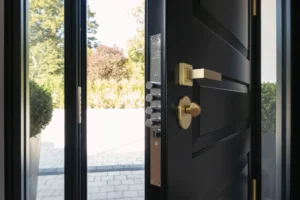
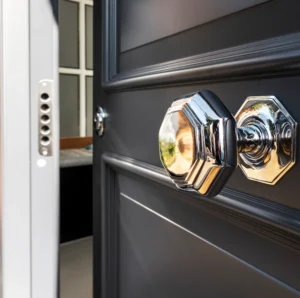
On the lock side, the system incorporates four active shoot bolts plus a central latch. These engage simultaneously and are operated by a single control method, whether that is a mechanical key or an electronic or biometric access system.
In addition to lateral locking, the system drives one shoot bolt vertically into the top of the frame and one into the bottom. This vertical engagement is critical. It resists lifting forces, limits door flex, and improves stability under attack.
On the hinge side, security is reinforced through four to six non-moving interlocking bolts, depending on door height. These fixed bolts engage automatically when the door closes, interlocking with the frame to prevent hinge-side peeling or forced separation.
Together, these elements create a perimeter-wide locking strategy rather than a single defensive point.
One Operation, Controlled Simplicity
Despite the complexity of the locking system, operation remains deliberately simple. All standard locking points are engaged through one primary action, whether mechanical or electronic.
This is particularly important in residential and mixed-use developments, where usability must match security. A system that requires multiple actions or specialist knowledge introduces risk. Unified operation ensures that high-level protection is delivered without compromising day-to-day use.
Optional Locking Enhancements for Higher-Risk Projects
While the standard configuration already delivers strong protection, certain projects require additional control or redundancy.
For these cases, clients can specify an additional deadbolt at the primary locking position. This adds further resistance where risk assessments, insurance requirements, or client briefings demand it.
Projects may also include one or two additional sets of shoot bolts on the lock side. These can be positioned at any height, making them suitable for oversized doors or unusual proportions. Depending on the access strategy, these additional bolts can be operated from the main key system or controlled independently.
This flexibility allows locking strategies to be tailored precisely to the threat profile of each project.
Multipoint Locking and Certified Performance
Multipoint locking plays a central role in achieving forced-entry certifications such as LPS 1175, where attackers are permitted to target locks, hinges, edges, and central areas separately.
Certification guidance from BRE / LPCB highlights that products must perform consistently across multiple attack points, not just at the lock location.
A door that relies on a single locking point is unlikely to meet these requirements. By contrast, multipoint locking distributes resistance across the entire assembly, supporting reliable, repeatable certified performance.
Why This Matters for Architects and Trade Partners
For architects and specifiers, multipoint locking supports both performance and design intent. Because resistance is achieved structurally rather than visually, doors can maintain clean lines, traditional detailing, or bespoke finishes without compromise.
For trade partners and contractors, it simplifies specification. Instead of layering additional hardware, multipoint locking provides a tested, integrated solution that aligns with certification and risk-management requirements.
You can see how this approach integrates with certified systems in our LPS 1175 SR3 security doors.
The Security Doors Factory Approach
Security Doors Factory designs locking systems as part of the door’s structure from the outset. Every configuration is engineered to suit door size, weight, use case, and certification requirements.
We supply exclusively to the trade, supporting door and window resellers, developers, contractors, and architectural teams. Our role is to deliver security doors that are technically robust, clearly specified, and suitable for projects where security and design must work together.
For insight into how these systems are engineered, see How Our Security Doors Are Made.
Conclusion
Multipoint locking is fundamental to modern security door performance. By securing the door leaf at multiple points along every critical edge, it transforms the door from a potential weak point into a reinforced structural element.
Through standardised multipoint locking and configurable enhancements, Security Doors Factory delivers multipoint locking security doors that meet professional expectations for usability, certified performance, and architectural flexibility.
To explore how these systems are applied in real projects, visit our Security Door Gallery.
Frequently Asked Questions
Multipoint locking secures a door at several points around its perimeter rather than relying on a single lock. This distributes force, improves stability, and significantly increases resistance to forced entry.
As standard, SDF doors include multiple active shoot bolts on the lock side, vertical shoot bolts into the top and bottom of the frame, and four to six interlocking bolts on the hinge side, depending on door height.
Yes. The standard configuration engages all primary locking points through one action, whether via a mechanical key or an electronic or biometric access system.
Yes. Clients can specify extra deadbolts or additional sets of shoot bolts positioned anywhere along the lock side, operated either together with the main lock or independently.
Forced-entry testing targets multiple areas of a door assembly. Multipoint locking ensures resistance is distributed across all critical zones, supporting consistent performance under certification standards such as LPS 1175.