LPS 1175 SR3 Security Doors: A Trade Guide

LPS 1175 is one of the UK’s most respected and demanding forced-entry testing standards, created by BRE Global / LPCB. Within this system, Security Rating 3 (SR3) marks a significant step into genuine high-security performance. It represents a point where a door must withstand an experienced and determined attacker using a challenging and varied hand-tool kit.

At Security Doors Factory (SDF), our doors are independently tested and certified to LPS 1175 SR3. This gives trade partners, architects, and resellers confidence that they are specifying a door with proven, third-party-validated security credentials suitable for demanding residential and commercial projects.

What SR3 Really Means

SR3 simulates a deliberate, skilled forced-entry attempt. Unlike lower security ratings, which represent opportunistic attacks, SR3 testing assumes that the intruder understands how door systems work and knows how to exploit weaknesses. The test is designed to push every part of the door, not just the lock or the hinges, to ensure the entire assembly performs consistently under pressure.

The attacker is equipped with heavier striking tools, pry bars, chisels, saws, drills and other destructive tools classified under “Category D.” These are capable of causing serious damage to anything that is not specifically designed and reinforced to resist them. For this reason, SR3 certification represents a meaningful performance level rather than a marketing claim.

The UK’s National Protective Security Authority (NPSA) also provides detailed guidance on forced-entry protection, emphasising the importance of fully tested door assemblies and consistent security performance across all building elements.

The SR3 Toolkit: What the Door Must Resist

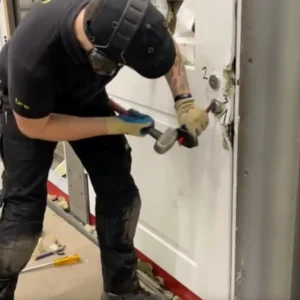
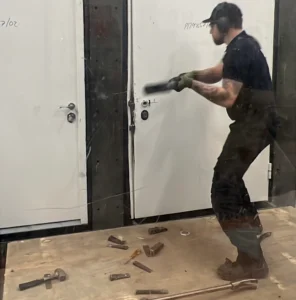
To appreciate the severity of the test, it helps to understand the tools involved. The toolkit includes club hammers, claw hammers, chisels, cold chisels, pry bars up to 660 mm, drills with high-speed steel bits, and a range of saws. The tester is free to switch between tools, adjust technique and explore weak points around locks, hinges, frames or the centre of the leaf.

Although SR3 does not permit grinders or powered cutting tools such as jigsaws or reciprocating saws – those appear in SR4 – the allowed tools are more than capable of destroying conventional residential doors in moments. SR3 begins at the point where the door must fundamentally change from “reinforced” to “engineered.

How SR3 Attack Timing Actually Works

A common misconception is that SR3 gives the attacker five minutes to attack the door as a whole. In reality, LPS 1175 divides the door into several independent attack zones, each tested separately.

For each zone, the tester receives up to five minutes of effective working time, meaning time actively spent applying force. The total duration of each attack sequence is longer, because attackers pause, change tools and reposition.

However, the critical point is this:
SR3 requires the door to survive multiple five-minute attacks at different locations – not one.

These attack zones typically include:

  • the lock and cylinder
  • hinges
  • the bottom edge
  • the frame interface – trying to wedge door open
  • the centre of the door leaf (to attempt creating an aperture)

If the tester succeeds in any one of these attacks within the allotted working time, the product cannot achieve SR3.

This structure makes SR3 substantially more demanding than it first appears. A door that can handle five minutes on the lock may still fail on the hinge side, and a door with strong hinges may collapse when attacked at the centre. Every part of the design must therefore work together.
Why SR3 Is Specified in High-Value Projects

SR3 is increasingly used in luxury residential properties, premium apartments, commercial buildings, equipment rooms and safe rooms. Developers and architects working in London, Manchester, the Home Counties and similar markets often specify SR3 as a baseline for main entries and sensitive internal areas.

International buyers, particularly those familiar with systems like EN 1627 RC3, immediately recognise SR3 as a comparable and trustworthy standard. As a result, trade partners gain a competitive advantage by offering certified SR3 solutions that meet global expectations.

How SDF Achieves SR3 Certification

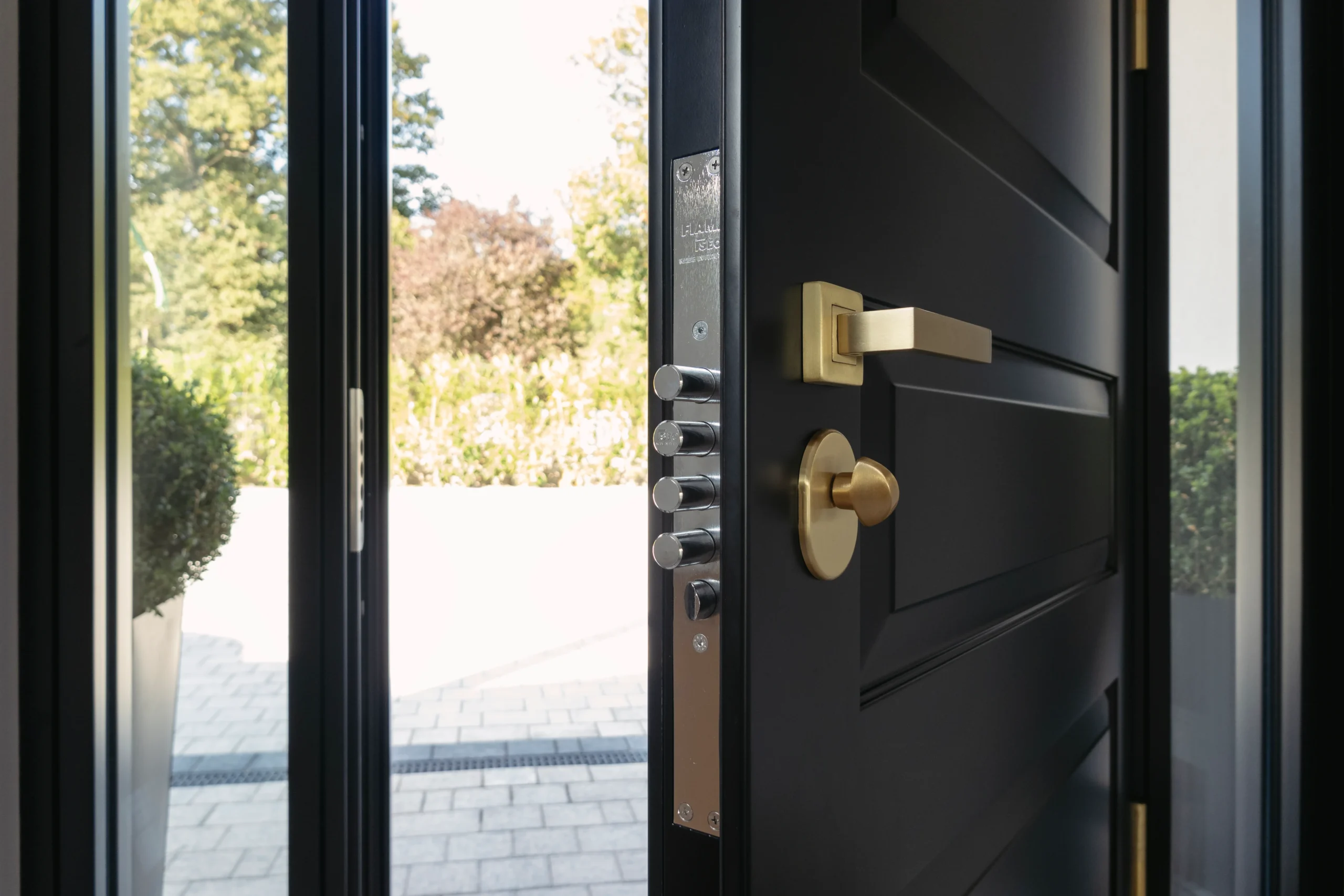
At SDF, our LPS 1175 SR3 security doors are built as complete systems. This system-based approach is essential, because the test challenges every part of the assembly.
Our designs incorporate:

  • Reinforced steel cores capable of resisting sustained chiselling, drilling, striking and levering
  • Deeply integrated locking systems protected against mechanical attack
  • Four-directional locking that secures the door from multiple points to maintain exceptional solidity
  • Hinges welded into frame and designed to prevent peeling or prying
  • A full-steel sheet within the door leaf that significantly increases rigidity and resists forced-entry attempts
  • Tight manufacturing tolerances that reduce tool access and leverage points
  • Bespoke finishes that allow architectural freedom without compromising strength
Conclusion

LPS 1175 SR3 is a rigorous, credible and internationally respected benchmark. It requires a door not only to look secure but to withstand a series of aggressive, skilled and targeted attacks across several points on the assembly.

For architects, contractors and resellers, specifying an LPS 1175 SR3 security door means choosing a product that has been engineered and tested to a meaningful performance level – one that stands up to modern security expectations.

Security Doors Factory supplies SR3-certified doors exclusively to trade partners, providing a dependable solution for high-end residential and commercial projects where performance and design must coexist.

Frequently Asked Questions

Leave a Comment

Your email address will not be published. Required fields are marked *

Scroll to Top